The Digi4MSK project on digital behaviour and trends on online musculoskeletal health content in Europe applied a mixed methods empirical research approach.
This entailed the conduction of an in-depth keyword analysis – integrating country-specific expert panels in Austria, Denmark, Ireland, Italy and Spain, a network analysis of complementary quantitative data and the characterisation and evaluation of online sources. Additionally, a European wide online survey has been carried out as part of the project’s research approach and was employed for a comparative analysis, synthesising the two analysis paths.
The step-by-step implementation of the Digi4MSK study first and foremost considered experts’ insights on the definition of relevant keywords for online searches on musculoskeletal health in Europe. Guided by an SSH-expert, the panels relied on the healthprofessionals’ engagement and their contributions to a selection of relevant terms, which was enhanced by quantitative data on frequency of searches. As part of an asynchronous participation and analysis process, the keyword lists were refined in multiple feedback loops by the selected European experts and picked up in an additional step to identify related topics and queries.
Table 6 Austria - Expanded List of Keywords
German keyword
Root Keyword
Ø Monthly Searches
English keyword
Root Keyword
Ø Monthly Searches
arthrose
Arthrose
50000
stiff neck
neck pain
500
arthrose behandlung
Arthrose
5000
neck pain
neck pain
500
arthrose schmerzen
Arthrose
500
arthritis
arthritis
5000
bandscheibenvorfall
Bandscheibenvorfall
50000
rheumatoid arthritis
arthritis
500
bandscheibenvorfall behandlung
Bandscheibenvorfall
5000
back pain
back pain
500
bandscheibenvorfall schmerzen
Bandscheibenvorfall
500
hernia
hernia
5000
eingeklemmter nerv was tun
eingeklemmter Nerv
5000
frozen shoulder
joint pain
5000
gelenkschmerzen
Gelenkschmerzen
5000
joint pain
joint pain
5000
knochenschmerzen
Gelenkschmerzen
500
jumper's knee
knee pain
500
hexenschuss
Hexenschuss
5000
knee pain
knee pain
500
hexenschuss symptome
Hexenschuss
500
runners knee
knee pain
500
knieschmerzen
Knieschmerzen
5000
lumbago
lumbago
5000
nackenschmerzen
Nackenschmerzen
5000
nackenverspannung
Nackenschmerzen
500
steifer nacken
Nackenschmerzen
500
rheuma
Rheuma
5000
rheuma behandlung
Rheuma
500
rücken verspannt
Rückenschmerzen
500
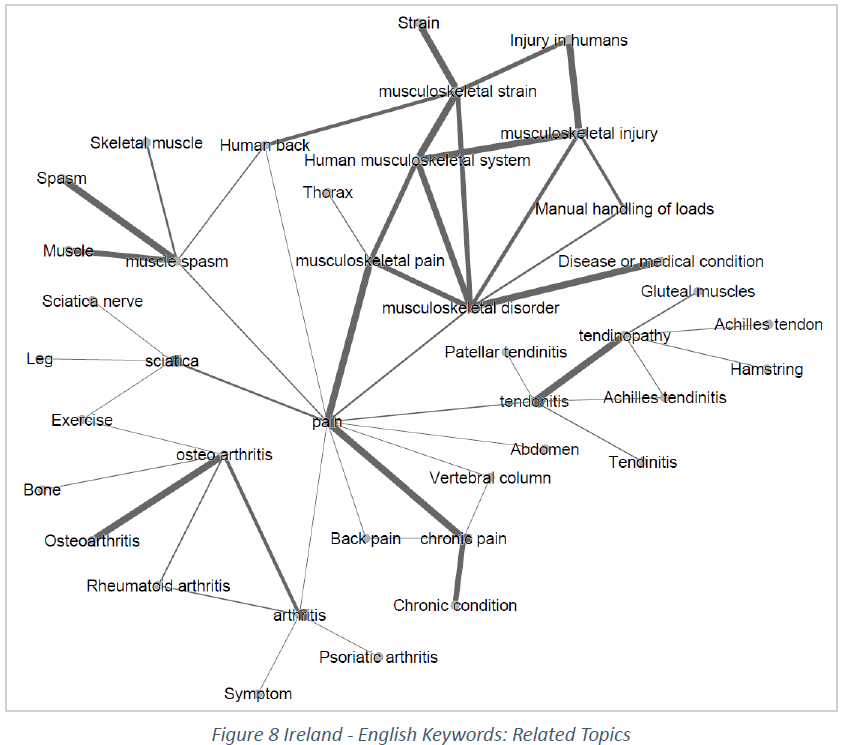
The keyword analysis subsequently resulted in the generation of simplified network graphs employing a descriptive statistics tool. Nodes within the graphs thereby represent the keywords and related topics or queries, lines (edges) connecting these nodes illustrate the degree of association between the searched terms by referring to their relative search volume.
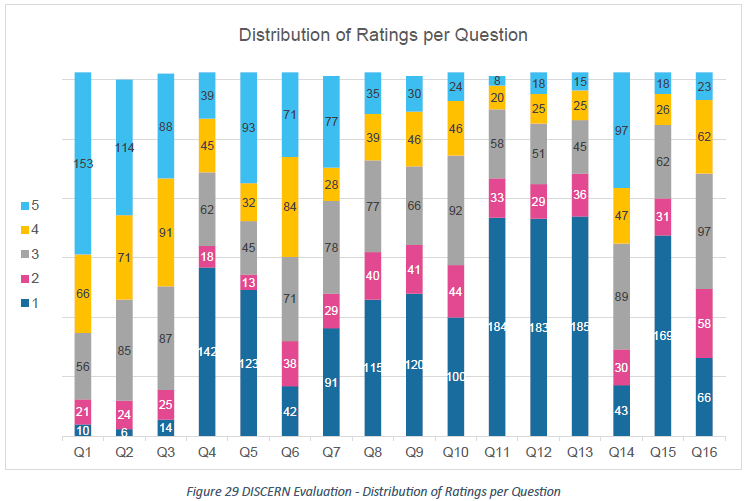
In a second and third phase of the research process, a sample of the most visited and relevant online sources per studied country was determined, characterised and in a final step evaluated by implementing the DISCERN instrument on the assessment of trustworthiness and quality of health information sources.
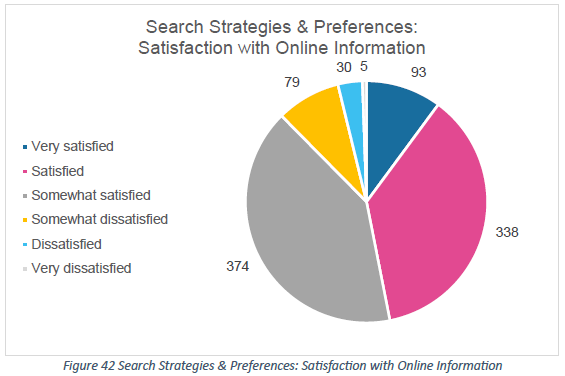
Finally, under the objective of obtaining a detailed analysis of the online health information-seeking behaviour of health professionals as well as non-health professionals, a European wide online survey was launched, analysed and comparatively discussed in consideration of the results from the expert panel-guided research. Focussing on (1) Socio-demographics, (2) Musculoskeletal Pain History, (3) Search Strategies and Preferences and (4) Online Health Information in General, the survey compiled over 1.000 participants and allowed for an insightful statistical analysis of the gathered data.
Overall, the qualitative and quantitative approaches of the mixed-methods analysis, including five expert panels, quantitative analysis tools and an online survey, innovatively showcase the worth and value of social sciences contributions to research and innovation projects in the health research domain.
For further insights, check out the full version of the “Report on digital behaviour analysis and trends on online musculoskeletal health content”.